Pages

Tuesday, June 26, 2012

Come Sail Away

My father was an aerospace engineer who designed airplane galleys and at one time he was a lead engineer on a developmental aircraft called the K16. His real obsession, though, was ships and he exercised this passion as a part time naval architect. Our house was littered with detailed drawings of sailboats big and small. He also wrote for a couple boating magazines and was a supporter of Mystic Seaport.

We spent many weekends walking the grounds of Mystic Seaport. My father couldn’t get enough of the old sailing vessels. Sadly, he never realized his dream to own a boat, but he never stopped dreaming that he might have one.

Alas, I did not share my father’s ardor for the sail. As a youth our trips to Mystic were mind numbing. My interest in the Charles W. Morgan, a whaling vessel, was ok the first couple times through her but my interest quickly waned. Not so Dad. He could stroll her deck for hours.

Sailboats have been in use for centuries. According to kidcyber.com by 2500 BC the Egyptians were using sailing vessels to cross oceans.

DVICE.com reports that almost 90% of consumer goods travel by water which means that when fuel costs increase so does the price of the cargo carried by ships.

Additionally, these ships use fossil fuels leaving a large carbon footprint.

Courtesy Google Images
One company, B9 Shipping, is developing a cargo ship that will use the DynaRig. The DynaRig is a system of sails that is computer operated. These vessels will still require an engine for those times when the wind is insufficient, however, it will only be needed roughly 40% of the time.

DVICE.com writes that the engines will be powered entirely by biogas, derived from sources like municipal food waste, making them carbon-neutral.

I think it’s exciting that a proven technology could be enhanced in such a way that today’s commerce needs could be met in an environmentally sound manner. What do you think? Do you think sail power is the future of trade?

Tuesday, June 19, 2012

Happy Father’s Day

I saw a Shoebox greeting card which read something like, “How did Father’s Day originate? Because a few weeks after Mother’s Day, someone said, ‘Hey, wait a minute!’”

What … I thought it was humorous.

According to
The Great Idea Finder, Father’s Day was the brain child of Mrs. Sonora Smart Dodd of Spokane, Washington. In 1910, two years after the advent of Mother’s Day, Mrs. Dodd sought a way to honor her father, a Civil War veteran, who raised her and her five siblings after their mother perished during childbirth.

In 1972, the
Nixon administration permanently established Father’s Day.
 

This year, for Father’s Day, my wife treated me to dinner on Saturday night: a man-sized rack of BBQ pork ribs that brought me to my knees. I had to admit, reluctantly, that I was unable to eat the whole portion and had to request the proverbial doggie bag. I’ve made concession to age. In a bygone era, I would have finished my meal, my wife’s meal, my dessert and her dessert.

Sunday, we travelled to Weymouth, MA and picnicked with our family. For the first time in a while, we were able to have all three boys, our daughter-in-law and our grandson under the same roof.

All-in-all, I’d call my Father’s Day weekend a winner.

How about you folks? Anyone care to share their Father’s Day celebration? Leave a comment below.


From left to right
Tyler, Me, Dan & Nick

Monday, June 11, 2012

Old, Tired Tires

My May 21, 2012 post discussed Google’s driverless car. The concept of a car that does the driving for its passenger wowed me. I had visions of reading and doing crossword puzzles while I sat behind the wheel.

I admit I’m having some doubts regarding the sensibility of a completely automated vehicle. How would such an automobile respond in an emergency situation? The articles I read discussed the car’s reaction to normal traffic issues such as a pedestrian crossing the road unexpectantly. But, what would happen if a tire blew out in heavy traffic at 60-plus miles per hour?

Remember, tires are age sensitive; they have a finite life. The manufacturers add chemicals to the tires to make the treads last longer but rubber still ages, and over time will fatigue. There may not be any visible signs of age, such as cracking or worn treads, but old tires can be hazardous.

Jon Christian Ryter quoted a Ford Motor Co. caution on the subject. "Tires degrade over time," the Ford warning noted, "even when they are not being used. It is recommended that tires generally be replaced after 6 years of nominal service.”

Tirerack.com reported that in 2001 the British Rubber Manufacturers Association (BRMA) stated, "BRMA members strongly recommend that unused tyres should not be put into service if they are over six years old and that all tyres should be replaced ten years from the date of their manufacture."

You may wonder why I think this is an issue. On Friday, June 8th, we drove to Ohio to celebrate our niece’s graduation from The Ohio State University. We were driving in the right lane on Route 90 West, just outside of Cleveland, in fairly heavy traffic, when our left front tire popped. Actually, the tread separated from the wheel. The car jerked to the left slightly but I never lost control and we were able to pull off the highway onto the grassy shoulder. 
Highway Tire Change


We were lucky. I’ve read some horror stories regarding incidents such as this. The tire that blew was over eight years old. I replaced all four when we got to our destination.

How do you know if you have old tires? There’s a manufacture date code on the tire and it is easy to decipher. Right after the DOT there should be a four digit number. The one on my tire was 1704. This means the tire was manufactured in the 17th week of 2004.  
 

What do you think, will you check your tires, even if you’ve just bought them, to make certain they are new?

Monday, June 4, 2012

Homemade Hovercraft

About.com, Inventors, describes a hovercraft as a vehicle supported on a cushion of air supplied by a powered fan mounted on the craft. According to Dover Lock and Key of the Kingdom, it was invented by a British engineer, Christopher Cockerell, in 1956. In July, 1959, the Saunders Roe Nautical One (SRN1) became the first hovercraft to navigate the English Channel.

How cool would it be to own a hovercraft? For $200K you could buy an awesome one from Universal Hovercraft. I think that’s a little out of my price range.

Adam Savage of the Discovery Channel’s Mythbusters has provided plans for building a homemade hovercraft for a lot less. To build it, all you need are materials found in the garage:
  • 1 sheet of ¾-inch plywood (get the cheapest you can find; quality is not an issue)
  • 1 leaf blower (gas or electric)
  • 1 heavy-duty shower curtain
  • 2 rolls of duct tape
  • 1 lid from a gallon paint can
  • Foam pipe insulation
  • Assorted screws
It doesn’t look all that hard. What do you think: are you ready to whoosh around your driveway on a cushion of air?

Monday, May 28, 2012

SpaceX – A New Era in Space Travel

There are a number of nations (e.g., the United States, Russia, China, India and Japan) that have satellites in orbit. Only a few nations have demonstrated the ability to launch spacecraft (Russia, the United States, the European Union, China, Japan, and India).

One sovereign nation, North Korea, has made three failed attempts (2006, 2009 and most recently April, 13, 2012) to launch weather satellites. The suspicion is that these launch attempts are thinly veiled tests of a ballistic missile delivery system.


Courtesy Google Images
Therefore, when SpaceX sent a cargo capsule, the Dragon, that docked with the International Space Station (ISS) on Friday, May 25, 2012, they accomplished something that no other private citizen had—build a spacecraft that docked with the ISS. I think it’s remarkable that they achieved this feat in just ten years.

There are other competitors in the commercial space realm. According to the Washington Post there are five other company’s which may be close to following SpaceX into orbit.


· Orbital Sciences Corp. of Dulles, Virginia
· Alliant Techsystems, headquartered in Arlington, Virginia
· Boeing Co. of Chicago, Illinois
· The Sierra Nevada Corp. of Sparks, Nevada
· Blue Origin of Kent, Washington

SpaceX was founded by Elon Musk, the creator of PayPal, in 2002. SpaceX’s COTS 2 Mission Press Kit states that Musk’s vision was to eventually make it possible for people to live on other planets.

What do you think? Is this the first step toward commercialization of space?

Monday, May 21, 2012

Driverless Cars

I often pondered about ways to smooth out traffic patterns on our highways. It seemed to me that the greatest problem was people not moving at the same, consistent pace.

Courtesy Google Images
You know what I’m talking about; it’s rush hour and traffic backs up because there’s all these ramps spewing cars that are trying to merge onto the thoroughfare. Drivers have to slow down to allow cars in; or they make lane changes to avoid the incoming vehicles; everyone’s tapping their brakes, which creates a ripple effect that cascades back through traffic, sometimes for miles (ever been on the Mass Pike on Easter Sunday?). I don’t even want to talk about the effects of an accident; a fender bender during a busy time creates chaos!

I wondered if there could be a system that would take over a car’s driving functions as that car entered a limited access roadway. In my fantasy system, once a driver entered an onramp, a master computer took control, merged traffic and moderated speed.

We already have cars that can park themselves (2012 Ford Focus). Chrysler minivans have a feature that warns the driver if another car is in its blind spot.

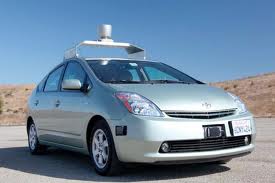
Google has taken it to the next level. They have developed a car that is driverless. The Washington Post reports the car, based on a Toyota Prius, has driven over 250,000 accident free miles and has been licensed for use in Nevada. CNN Money reporter, Peter Valdes-Dapena , details a ride through a predetermined route in Washington, DC. Valdes-Dapena writes that the Google car handled unexpected occurrences, such as avoiding a collision, on its own. Currently, a pair of engineers is required to sit in the front seat to monitor the vehicle’s operation, but their input is limited to operating the turn signals.

Not to be outdone, according to The Telegraph, General Motors has announced that self-driving cars will be available within a decade.

I am fine with the prospect of being able to just sit back and let the car do all the work. What do you think; are you ready to give up your control behind the wheel?


Monday, May 14, 2012

Asteroid Mining


In 1848, at Sutter’s Creek, California, gold dust was discovered and the rush for gold was on. Within a year, 100,000 people migrated to California with the hope of striking it rich. In 1896, Rabbit Creek, in the Klondike Valley of the Yukon Territories was the scene of another golden discovery. According to The Last Best West, a prospector found a gold nugget and the ensuing Klondike Gold Rush drew 100,000 pilgrims to the gold fields of Canada.
Courtesy Google Images
In May, 2003, the Japanese launched a meteor probe named Hayabusa. It collected granules of meteoroid dust from the asteroid Itokawa and returned to earth with its space dust in June, 2010.

I think this mission was important for a couple of reasons. It gave scientists a glimpse of the composition of an asteroid and it proved that a space craft could land on and return from an asteroid. In 2016, NASA plans to send an unmanned rocket to an asteroid. The Telegraph reports that astronauts have begun training for a manned mission to an asteroid.

The significance to the gold rush? Asteroids could contain a host of precious metals and a group of business people have proposed mining asteroids. ABC News reports that Planetary Resources, Inc has a vision of collecting precious metals and water from space. Co-founder Eric Anderson said, "If you believe it's important to have continued prosperity for future generations, we need resources from somewhere."

The proposition won’t be cheap but these folks have the backing of some high rollers such as Larry Page, co-founder and CEO of Google and Eric Schmidt, Google's executive chairman.

I think it would be cool to mine asteroids; as long as we don't abandon manned space flight. What do you think; will this lead to a rush for metal ores in the great vacuum of space?